Whether you are entering the region for the first time or considering moving your business, Hong Kong and Singapore are among the top choices for international expansion in Asia. Known for their strategic locations and global connectivity, they are often compared as leading regional hubs. Despite these similarities, they offer two distinct environments for company setup, taxation, regulation, and regional access. Each has its own set of advantages and challenges.
So, which city is the right fit?
This article offers a practical comparison of the two cities, covering everything from business infrastructure to banking and relocating to each city, to help you decide where to set up your company and what that choice means for your next move.

Eyeing the Middle East as well? Compare Hong Kong vs Singapore vs Dubai in our full report.
Choosing Between Hong Kong and Singapore: A Quick Verdict
Before diving into the details, here’s a quick look at how Hong Kong and Singapore compare when it comes to setting up and running a business.
Hong Kong
✅ Choose Hong Kong if your business focuses on China and operates in finance, trading, or professional services.
✔️ 100% online company registration
✔️ Strong connections to mainland China ✔️ 0% offshore tax ✔️ More accessible for non-residents, as there is no local director requirement ✔️ Low setup and ongoing costs ✔️ Simple, territorial tax system ✔️ Banking access includes RMB (Chinese Yuan) currencies. ✔️ Suited for service-based sectors like finance, logistics, consulting, and cross-border trade 
Singapore
✅ Choose Singapore if you’re building a tech or IP-driven company and want a stable base for regional ASEAN growth.
✔️ 100% online company registration
✔️ Strong connections to mainland China ✔️ Strong R&D incentives. ✔️ Strong intellectual property protection ✔️ More cost-effective setup if you have local ties; otherwise, higher overall incorporation costs for foreigners (Requires at least one resident director). ✔️ broader network of income tax treaties ✔️ Attractive for startups, regional headquarters, and businesses targeting ASEAN, like Malaysia and Thailand. |


Insight: A recent survey by Statrys found that 65.3% of businesses preferred Hong Kong over Singapore. The primary reason cited was Hong Kong's favourable tax regime, with rates starting at 8.25%, compared to Singapore's flat rate of 17%.
Real Business Scenarios
Here's how different business models might approach the decision:
Ecommerce importing from China: You're sourcing products from Shenzhen and selling globally through Amazon, Shopify, or other channels. Hong Kong gives you proximity to suppliers in the Chinese market, easier communication across the border, and lower shipping costs. The straightforward tax regime and lack of GST on imports make inventory management simpler.
SaaS company targeting Southeast Asia: You've built a B2B software platform and need to establish trust with enterprise clients across Malaysia, Thailand, and Indonesia. Singapore's stronger IP protection framework, government grants for tech startups, and strategic location in ASEAN make client meetings and regional expansion more practical.
Consulting business with international clients: You provide management consulting to clients in Europe, North America, and Asia. If your income comes from services delivered outside your base jurisdiction, Hong Kong's offshore tax exemption could reduce your effective rate to 0%. Singapore works better if you need the credibility of Double Taxation Avoidance Treaties with 100+ countries.
Economic Landscape: What It Means for Your Business
Both economies are open, trade-focused, and highly regulated business hubs with strong legal systems and comprehensive corporate services.
Singapore may suit you if you want a base to build and scale across Southeast Asia, especially in tech or R&D, backed by long-term policy planning and strong capabilities in finance, technology, manufacturing, and ICT.
Hong Kong is suited if your business depends on deal-making, finance, trade, or access to China and the Greater Bay Area.
Here's how Hong Kong and Singapore compare economically:
| Factor | Hong Kong | Singapore |
|---|---|---|
| IMD Competitive Economy Ranking | 3rd | 2nd |
| Expected GDP Growth for 2026 | 2.3% - 3% | 1% - 3% |
| Key industry | Financial services, tourism, trade, logistics, and professional services | Financial services, tourism, ICT, and manufacturing |
| Market Focus | China, Greater Bay Area | ASEAN, global HQs, R&D-intensive businesses |

Fact: While both Hong Kong and Singapore are known for import and export, Hong Kong has a well-known reputation for free trade with duty-free imports and exports. Singapore serves as a global trade gateway and an offshore banking centre for foreign investors, offering affordable financing and easy export across ASEAN borders.
Company Incorporation: Where Is It Easier to Set Up?
Short answer: Hong Kong is a more flexible and affordable option for most foreign founders incorporating from overseas without an existing local presence. While government fees in Singapore are slightly lower, total incorporation costs are often higher for those without local partners, due to the need to appoint a local or nominee director. You also need Singpass* to access Singapore’s online registration system.
Although both jurisdictions require a local registered address and a locally resident company secretary, these requirements can be met through a service provider.
Both cities use English as an official language, and company documents can be filed online in English.

Tip: Check out our thorough guide to company registration in Hong Kong and company registration in Singapore to better understand the specifics for each location.
| Factor | Hong Kong | Singapore |
|---|---|---|
| 100% Foreign Ownership | ✅ | ✅ |
| Local Director Required | ❌ | ✅ |
| Fully Remote Setup | ✅ | ✅ |
| Local Company Secretary | ✅ | ✅ |
| Local Registered Address | ✅ | ✅ |
| Minimum Capital | HKD 1 | SGD 1 |
| Application Process Speed | 3 to 5 days on average | 3 to 5 days on average |
| Application Cost | HKD 3,745 to 3,920 (USD 480 to 500) for application fees and 1 year business registration | SGD 315 (around USD 234) for registration fees |
| Total Cost** | Average HKD 9,053 (around USD 1,200) |
SGD 3,000 to 8,000 (around USD 2,300 to 5,900) |

Remark *,**
Taxation: Where Do You Save More?
In most cases, international businesses save more in Hong Kong due to lower effective tax rates and the availability of offshore tax exemptions, while Singapore delivers greater savings mainly for startups or R&D driven businesses that qualify for incentives.
| Category | Hong Kong | Singapore |
|---|---|---|
| Corporate tax rate | 8.25% on first HKD 2M, 16.5% thereafter | Flat 17% |
| Notable tax incentives | Offshore income exemptions, tariff exemptions on general imports | Tax exemptions for startups for first SGD 200,000; more deductions for R&D businesses |
| Offshore income tax | 0% tax for applicable companies | N/A |
| Capital gains tax | ❌ | ✅ |
| Dividend tax | ❌ | ✅ |
| GST / VAT | ❌ | 9% |
| Double Taxation Avoidance Agreement (DTA) network | 50 countries | Over 100 countries |
Tip: Check out our guides on the Hong Kong tax system and the Singapore tax system to learn more.

Banking and Financial Infrastructure: Which Provides Better Access?
Hong Kong and Singapore are both top global financial hubs but the banking experience differs for residents and non-residents.
For non-resident business owners, opening a business bank account in either city requires in-person verification, numerous documents, large initial bank deposits, and high daily/monthly balances. These are inhibiting factors for small businesses, but larger businesses could find these requirements reasonable.
In both locations,alternatives to traditional banks are seeing increased interest from SMEs. Licensed fintech firms and payment service providers offer online business accounts with multi-currency support and integrated FX tools. These accounts are easier to open remotely but are not classified as bank accounts.
Tip: Explore the best business accounts in Hong Kong and the best business account in Singapore, offered by both banks and non-bank institutions.
Hiring Talent: Where Can You Find the Right Skills?
Hong Kong's talent pool excels in finance, trade, and logistics. Singapore has stronger tech and STEM talent due to government investment in innovation. Both cities attract international workers.
Hong Kong's minimum wage is HKD 42.10/hour across most sectors. Singapore uses sector-specific Progressive Wage Models instead of universal minimums.
✅Choose Hong Kong for finance and professional services roles.
✅Choose Singapore for technology and research-heavy positions.
Tip: Explore our full guide on hiring employees in Hong Kong and the Employment Act in Singapore to better understand the process and employee benefit requirements in each jurisdiction.
Immigration Policy & Business Relocation: Where Should You Move?
Hong Kong provides a simpler residency pathway, while Singapore offers higher lifestyle scores and a more structured environment for global headquarters.
Residency and Visas
- Hong Kong offers permanent residency after 7 years of continuous stay, with eligibility tied to economic contribution. The process is clearly defined through work or investment visa options.
- Singapore does not set a fixed duration for permanent residency eligibility, though most applicants apply after six months to two years. The Global Investor Programme and EntrePass offer structured paths for entrepreneurs.
Office Rents
- Hong Kong office rents are higher than Singapore, but key business districts like Central and Tsim Sha Tsui remain well-connected and commercially active.
- Singapore office rents are slightly lower but they are set to equal Hong Kong by 2027, especially in the CBD and Marina Bay areas.
Singapore’s focus on green space, urban planning, and tech-forward initiatives has helped it become a world-class destination for regional headquarters. Hong Kong, while denser, maintains proximity to manufacturing bases in countries like China, Malaysia, and Thailand, making it well-suited for logistics and sourcing operations.

Resource: Explore our guide for a comprehensive overview of Hong Kong's immigration policies and Singapore's visa guide.
Living in Each City
When recruiting employees or relocating your team, quality of life and cost of living directly impacts your hiring costs and retention rates.
➡️ Housing
Housing in Hong Kong tends towards smaller, more expensive apartments, which can be challenging for families—factor this into compensation packages.
Singapore offers more housing variety through HDB flats and condos, though costs remain high in both cities.
➡️ Commuting
Commute times average 45-60 minutes in Hong Kong's dense environment compared to Singapore's 30-45 minutes, which may affect work-life balance for your team.
➡️ English Proficiency
English proficiency significantly impacts daily business operations. Singapore ranks 3rd globally in English proficiency, making integration smoother for international teams.
Hong Kong ranks 32nd, with more Cantonese in daily life outside business districts—consider this when building local teams or client-facing operations.
➡️ Public Transportation and Airports
Aside from business infrastructure, many founders consider factors like public transport and recreation. Singapore's MRT system and Hong Kong's MTR are both highly efficient, clean, and reliable and both airports offer extensive international connectivity.
➡️ Healthcare and Education
Both cities have excellent international schools and world-class healthcare systems. Hong Kong operates a dual public-private system, whilst Singapore uses the Medisave/Medishield framework.
Fact: In Statrys' survey, 75% of respondents in Hong Kong are satisfied with their expat life, while 85% in Singapore report overall satisfaction.
Future Outlook: What Lies Ahead for Businesses in Each City?
Hong Kong is integrating deeper with the Greater Bay Area, strengthening its role as China's financial gateway. Singapore continues investing in technology, sustainability, and digital infrastructure to attract startups and innovation-driven companies. Choose based on your target market: China-focused growth (HK) or regional ASEAN expansion (SG).
Which country sounds better for business?
Hong Kong
Singapore
How Statrys Can Help
If you’ve weighed the pros and cons of setting up in Hong Kong or Singapore and are ready to move forward, Statrys can help you put your plans into action.
We offer all-in-one incorporation packages for both Hong Kong and Singapore. The package includes everything you need to get started: a registered business address, a dedicated company secretary, a resident director in Singapore, and expert guidance on local compliance from day one.
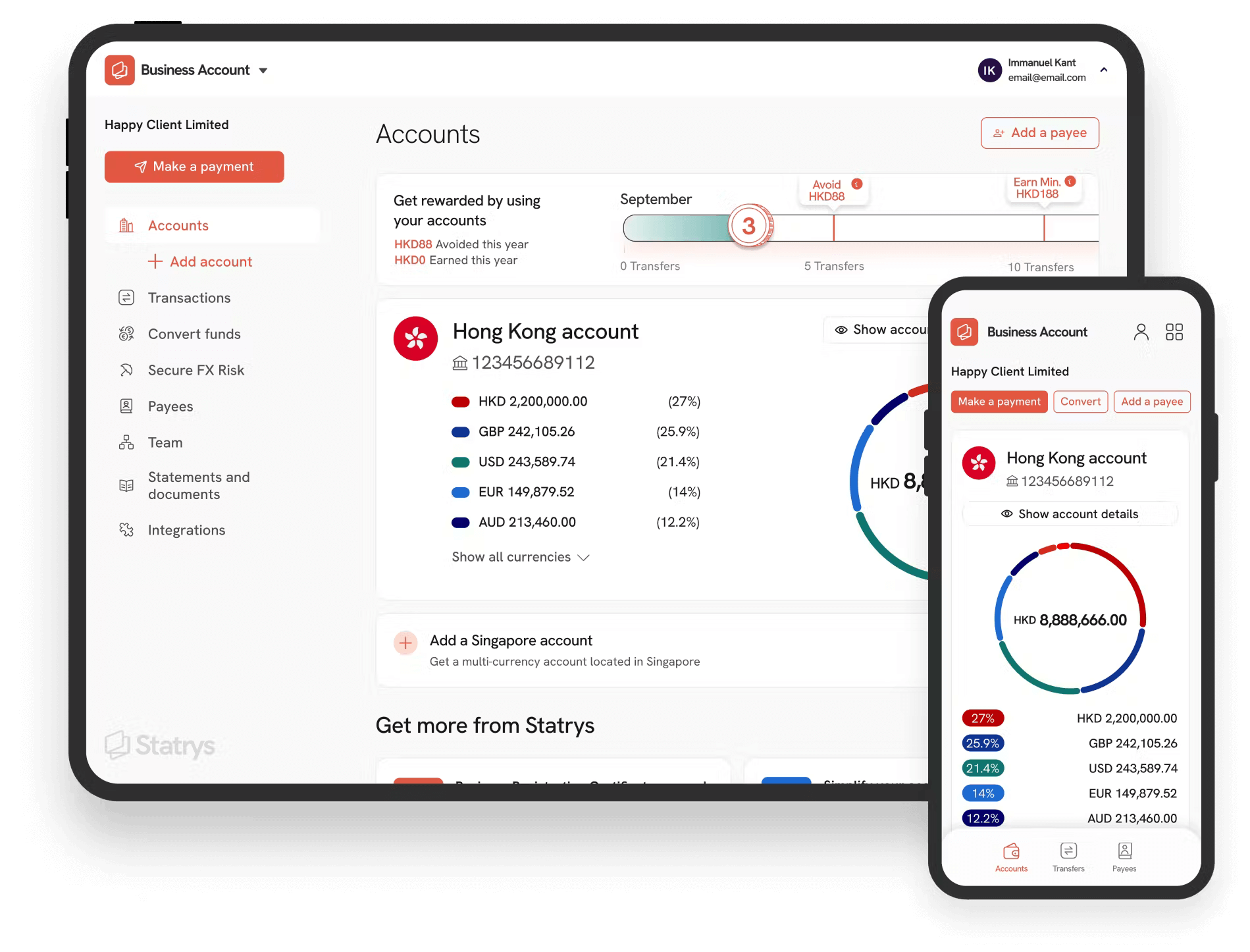
Once your company is up and running, we can also support your operations with a multi-currency business account (subject to approval) and accounting and bookkeeping services, so you spend less time managing admin and more time growing your business.
Got questions? Contact us to get the answers.
Was this article helpful?
Yes
No
FAQs
What Is the Difference Between Singapore and Hong Kong?
Singapore and Hong Kong are both Asian jurisdictions that are considered global financial hubs, but they differ in governance and regulation. Additionally, geographically, Singapore is in Southeast Asia, while Hong Kong is sometimes considered part of both Southeast Asia and East Asia. Unlike Singapore, Hong Kong is not a member of ASEAN.