Offshore bank accounts are a powerful tool for global entrepreneurs, investors, SMEs ecommerce businesses, and digital nomads aiming to diversify holdings, manage foreign currency, protect assets, or optimise tax exposure. Opening one in 2026 is no longer reserved for wealthy individuals or multinational corporations.
However, choosing the right offshore banking jurisdiction requires careful consideration of factors like account opening conditions, minimum deposit requirements, and regulatory compliance. This guide reviews the most attractive countries for offshore banking, outlining these key factors and providing examples of available account options in each jurisdiction.
Here are some key highlights
- Most SMEs and entrepreneurs will find that Hong Kong or Singapore offers a good balance of access, cost, and functionality.
- High-net-worth individuals should consider Switzerland or the Cayman Islands. Switzerland and the Cayman Islands excel in asset protection, but typically require higher deposits and in-person visits.
- UAE and Mauritius balance favourable regimes with growing compliance standards.
- Fully online account setup and lower minimums are possible in Hong Kong and Singapore through fintech platforms.


Note: Your home country’s tax and reporting obligations apply regardless of where you bank or hold financial account. Always consult a qualified tax professional to ensure compliance.
What Is an Offshore Bank Account?
An offshore bank account is a bank account opened in a foreign country, outside your home country’s jurisdiction. These accounts are commonly used by entrepreneurs, expats, and high-net-worth individuals to hold foreign currency, manage cross-border finance or protect assets. Offshore accounts often offer access to multi-currency support, foreign exchange, and international transfers.
While offshore banking is often associated with privacy laws and low tax rates, it's important to distinguish legal use from tax evasion. When done properly, offshore accounts offer legitimate advantages like asset protection, financial diversification, and more flexible banking options, as long as account holders comply with reporting requirements under frameworks like FATCA or their local tax laws.

Note: Want a deeper dive into how offshore banking works? Explore more in our full guide on what offshore banking is.
How to Choose the Right Offshore Bank Account
Choosing the right offshore bank account is no easy task. It’s not just about finding a low-tax country. It’s about balancing legal compliance, banking access, and operational efficiency based on your business goals.
Here are the key factors to evaluate before you open an offshore business account:
1. Jurisdiction Reputation
One of the most important factors when selecting an offshore bank account is the reputation of the jurisdiction. This not only helps protect your assets and keep your business operating within legal boundaries, but also affects how your company is perceived. Holding an account in a poorly regarded jurisdiction can create friction with partners, payment providers, and counterparties.
As a simple rule, avoid jurisdictions that are blacklisted by the EU.
2. Financial Institution Reputation
Before choosing an offshore bank, confirm the institution is licensed by asking about dispute resolution procedures, and check how deposit protection applies.
Top-tier regulatory environments:
- Singapore and Hong Kong: Regulated by MAS and HKMA, both offer strong governance and cooperate under FATCA and CRS.
- Switzerland and Mauritius: Maintain high banking standards with independent regulators and deposit protection frameworks.
Privacy-driven but scrutinised jurisdictions:
Cayman Islands and Panama: Known for tax neutrality and banking secrecy, but require careful documentation and full reporting compliance.

Tip: Ensure you're clear on your home country’s reporting requirements (e.g., FATCA, FBAR, CRS) because you’ll want to avoid compliance issues down the road.
3. Remote Account Opening Availability
If you are opening an offshore bank account from outside the jurisdiction, prioritise financial institutions that support full remote onboarding.
Ensure the entire process can be completed remotely. Many institutions, particularly traditional banks, allow applications to begin online but still require an in-person visit to complete approval.
What is possible remotely in many jurisdictions is applying for an account through licensed fintechs. These are not bank accounts, but regulated financial products primarily designed for payments and operational use.
What to confirm:
- All onboarding steps are remote (KYC, signing, activation)
- No later in-person visit is required to finalise or upgrade the account
- Remote clients are not subject to reduced limits or restricted services
If reduced functionality or later in-person requirements apply, the institution may be signalling that non-resident clients are not a core focus, which typically results in more friction over time.
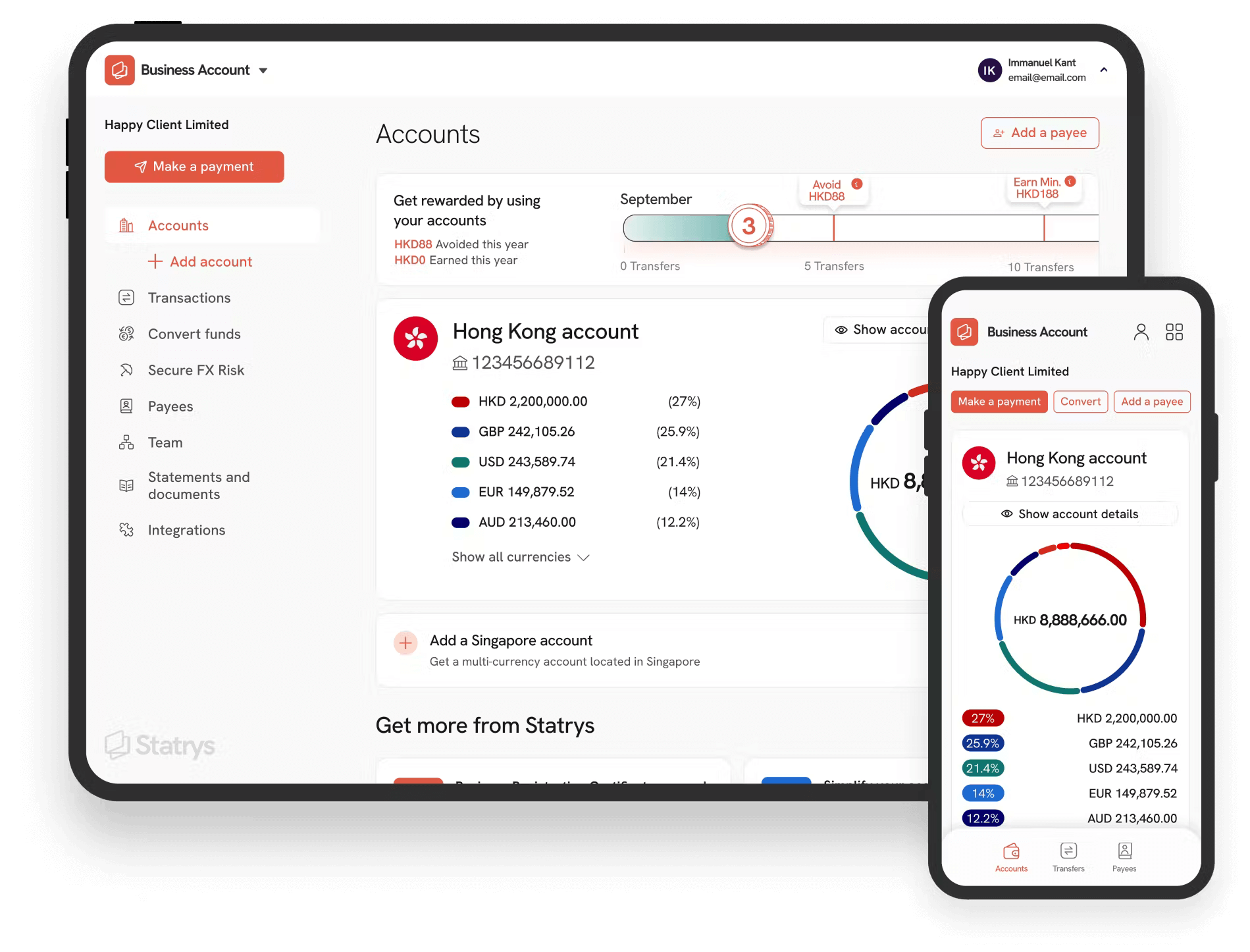
Get a business account in Hong Kong or Singapore through Statrys, a non-bank alternative, 100% online.
4. Initial Deposit and Ongoing Costs
Minimum deposit requirements vary widely depending on the jurisdiction and whether you’re dealing with a traditional bank or a fintech provider.
Low or no minimum deposit (via fintechs):
- Statrys (HK): No minimum deposit, zero monthly fee
Moderate to high deposits (via banks):
- Hong Kong (HSBC): HKD 10,000+
- UAE (Emirates NBD): AED 25,000+
- Panama & Mauritius: USD 5,000–10,000+
- Cayman Islands & Switzerland: USD 30,000–100,000+ (and often higher for private banking)
Beyond minimum deposits, offshore accounts come with other bank fees you’d expect anywhere, such as maintenance charges and transaction costs.
Tip: Always factor in monthly fees, fall-below charges, and FX costs when comparing options, not just the initial deposit.
5. Currency Support and Payment Capabilities
Accounts that hold multiple currencies reduce FX exposure by avoiding unnecessary conversions and letting you control when to exchange.
Strong multi-currency support (including USD, EUR, GBP, SGD, HKD):
- Hong Kong and Singapore banks and fintechs
- Switzerland (standard with most accounts)
- Mauritius and UAE (especially with premium SME accounts)
Limited or USD-only options:
Some Panama and Cayman banks may only offer USD as the main account currency, with fewer real-time FX tools or competitive rates.
Beyond currency holding, check how you can use those currencies. Some accounts allow holding only, while others allow holding and sending and/or receiving. Accounts that enable local-currency payments can reduce intermediaries fees, and speed up cross-border transactions.
Tip: Look for providers that let you send and receive in local account details (e.g., UK GBP, US ACH) to reduce third-party fees and FX margins.
Top Countries to Open an Offshore Bank Account 2026
Now that you know what to look for, here’s how some of the best offshore banking jurisdictions compare based on access, deposit requirements, supported currencies, and compliance.
1
Hong Kong
Globally recognised as a financial centre and known for its strategic role as a gateway to China and broader Asia, Hong Kong continues to be a preferred offshore banking hub for entrepreneurs, SMEs, and global investors.
Many financial institutions in Hong Kong offer multi-currency accounts, commonly supporting HKD, CNY, and USD, along with international financial services and strong networks. While account approval with traditional banks can be more challenging for small businesses without a local presence, opening a Hong Kong business account is still possible through regulated fintech and digital banks, which often offer more flexible onboarding options.
Hong Kong’s offshore banking features at a glance:
| Best Offshore Accounts | Statrys Hong Kong multi-currency account (non-bank), HSBC, Standard Chartered, Hang Seng, DBS |
| Remote Account Opening |
✔️ Available via some digital banks and fintechs. ❌ Traditional banks typically require an in-person visit or video interview. |
| Minimum Deposit & Fees |
Banks: Minimum deposit often HKD 10,000+ with balance maintenance requirements. Fintechs: Often no minimum deposit and may charge a fixed monthly fee. |
| Other Considerations |
|

Tip: If you're a foreign entrepreneur with no ties to Hong Kong, you might need to register a company in Hong Kong first before you can apply to open offshore accounts as a business.
2
Singapore
Whether you're a startup scaling across ASEAN or an SME managing multi-currency transactions, Singapore offers a streamlined entry point to global banking. With world-class infrastructure, progressive fintech regulation, and strong asset protection frameworks, the city-state is especially attractive for high-net-worth individuals and international businesses seeking secure yet flexible offshore solutions.
Its banking sector blends traditional institutions with MAS (Monetary Authority of Singapore)-licensed digital banks and payment platforms, a number of which support remote account opening. This balance of innovation and financial stability keeps Singapore at the forefront of offshore banking in the Asia-Pacific region.
Singapore’s offshore banking features at a glance:
| Best Offshore Accounts | Statrys Singapore multi-currency business account (non-bank), OCBC, DBS, ANEXT Bank, Aspire, Wise Business |
| Remote Account Opening |
✔️ Supported through licensed intermediaries and select fintech providers. ❌ Personal visit often required for traditional banks. |
| Minimum Deposit & Fees |
Banks: Typically SGD 1,000–5,000+ to open, with ongoing balance maintenance requirements. Fintechs: Lower or no minimum deposit, with some offering flexible fee models. |
| Other Considerations |
|

3
United Arab Emirates (UAE)
For businesses targeting growth across the Middle East, Africa, and South Asia, the UAE offers a blend of strategic location, modern banking, and jurisdictional flexibility. Free zones across Dubai, Abu Dhabi, and beyond provide streamlined pathways for foreign-owned companies to access offshore accounts.
The UAE offers a compelling choice for cross-border banking and a wide range of banking options, including multi-currency accounts, private banking, corporate banking, and investment management services. Dubai, in particular, is a renowned financial centre. While traditional banks often require a local presence, fintech innovation and regulatory support are gradually expanding remote onboarding options.
UAE’s offshore banking features at a glance:
| Best Offshore Accounts | Riyadh Bank, Emirates NBD, Mashreq Bank, RAKBANK, Wio Bank, HSBC UAE, Wise |
| Remote Account Opening |
✔️ Some banks and digital platforms allow remote onboarding via agents or video calls. ❌ Most traditional banks still prefer in-person setup or a UAE-based representative. |
| Minimum Deposit & Fees |
Banks: AED 5,000–50,000+ minimum deposit, depending on provider and account tier. Fintechs: Lower deposit thresholds, with possible monthly maintenance or onboarding fees. |
| Other Considerations |
|
Note: Comparing Hong Kong, Singapore, and Dubai can help you choose the right offshore banking destination. See our full report here.
4
The Cayman Islands
Often associated with private wealth and international finance, the Cayman Islands offers a specialised offshore banking environment with a strong focus on confidentiality and asset protection. The absence of direct taxation further enhances the appeal. Its legal system, based on English common law, supports a highly regulated financial sector
While banking in Cayman typically involves higher entry thresholds and detailed compliance checks, some financial institutions now provide more accessible options through intermediaries . This makes Cayman a relevant choice in 2026 for high-net-worth clients and businesses managing global assets.
Cayman Islands’ offshore banking features at a glance:
| Best Offshore Accounts | Cayman National Bank, Butterfield, Scotiabank Cayman, Jeton Bank |
| Remote Account Opening |
❌ Typically requires an in-person visit. ⚠️ Some banks allow onboarding via courier and authorised intermediaries. |
| Minimum Deposit & Fees | Traditional banks: Minimum deposit usually USD 10,000–100,000+, depending on the institution and account type. |
| Other Considerations |
|
Note: Offshore banking in the Cayman Islands is geared mainly towards private wealth management. SMEs and entrepreneurs may face stricter onboarding standards compared to other jurisdictions like Hong Kong or Singapore
5
Panama
Panama serves as a strategic gateway between North and South America, offering territorial tax benefits. Its dollarized economy, using the US dollar alongside the Balboa pegged 1:1 to USD, is unique among offshore jurisdictions. With over 60 international banks, Panama is a viable choice for managing cross-border transactions.
Following international reforms, Panama has modernised its banking compliance while maintaining some flexibility for non-residents. Historically known for accessible personal offshore banking, documentation and due diligence requirements have increased in 2026, though it remains a viable option, particularly for those with local ties.
Panama’s offshore banking features at a glance:
| Best Offshore Accounts | Banco General, Banistmo, BAC International, Citi Panama |
| Remote Account Opening |
⚠️ Partially supported via intermediaries or video verification. ❌ In-person presence often required for final approval. |
| Minimum Deposit & Fees | Traditional banks: Typically USD 1,000–5,000, though higher thresholds may apply for non-resident companies. |
| Other Considerations |
|
6
Mauritius
Mauritius is gaining traction as a strategic offshore banking location, offering accessible banking solutions for non-residents and a stable regulatory environment. Positioned between key markets in Africa and Asia, it provides businesses with a convenient base for regional and international operations.
With growing support for remote onboarding, a broad double taxation treaty (DTA) network, and streamlined compliance for foreign-owned entities, Mauritius appeals to companies seeking cost-efficient, globally connected banking services.
Mauritius' offshore banking features at a glance:
| Best Offshore Accounts | Mauritius Commercial Bank (MCB), SBM, AfrAsia Bank, Bank One |
| Remote Account Opening | ⚠️ Available through some banks and intermediaries. Enhanced checks for non-residents may apply. |
| Minimum Deposit & Fees | Traditional banks: Minimum deposits typically range from USD 5,000 to USD 10,000+. |
| Other Considerations |
|
7
Switzerland
Switzerland remains a top-tier choice for offshore banking, backed by its reputation for financial stability, legal consistency, and client-focused services. Long regarded as a safe haven for wealth management, Swiss banks are known for their reliability, discretion, and long-standing expertise in handling international assets.
While the country has adapted to global transparency standards, it continues to offer strong privacy and premium banking experiences, ranging from multi-currency accounts to tailored investment services, favoured by high-net-worth individuals and global institutions.
Switzerland’s offshore banking features at a glance:
| Best Offshore Accounts | UBS, CIM Banque, Dukascopy Bank, Swissquote |
| Remote Account Opening | ❌ Generally requires an in-person visit, although some banks allow remote onboarding through certified intermediaries or video calls. |
| Minimum Deposit & Fees | Traditional banks: High minimum deposits often starting from USD 10,000 to 1 million+, depending on the institution and service tier. |
| Other Considerations |
|
8
Belize
Belize is another popular offshore banking jurisdiction in Central America, particularly favoured by those seeking asset protection, privacy, and simplicity. Belize offers a variety of banking options, including both personal and business accounts, and a number of reputable international banks are available.
The country’s banking sector is structured to be flexible and welcoming to foreign clients, plus having a lower minimum deposit requirements than many other offshore jurisdictions.
Belize’s offshore banking features at a glance:
| Best Offshore Accounts | Belize Bank International, Jeton Bank |
| Remote Account Opening | ✔️ Possible via intermediaries. |
| Minimum Deposit & Fees | Typically USD 1,000–2,000, though higher deposits may apply for business accounts. |
| Other Considerations |
|
Open an Offshore Business Account with Statrys
If your goal is to launch in either Hong Kong or Singapore, Statrys offers company registration and a business account in both cities through a streamlined process, with no minimum deposit and 100% online.
With a Statrys business account, you can:
✅ Hold and manage 11 major currencies
✅ Send local payments in 12 currencies
✅ Send and receive international payments in over 100 countries with real-time tracking
✅ Competitive foreign exchange rates
✅ Support available via phone, email, WhatsApp, and WeChat
Start with the right jurisdiction, stay compliant, and choose a provider that makes global business feel local.
Tip: Want a step-by-step guide on opening an offshore account? Explore our full guide on how to open an offshore bank account.
Was this article helpful?
Yes
No
FAQs
Is it illegal to have an offshore bank account?
No, it is not illegal. Offshore banking is legal when used for legitimate purposes and properly disclosed to tax authorities. It only becomes illegal if it involves activities like tax evasion, money laundering, or failing to meet reporting obligations.