Key Takeaways
A foreign currency account is an account that allows you to hold one or more currencies other than your local currency.
Foreign currency accounts can reduce currency conversion costs and payment delays.
If you get paid in another currency or regularly send money abroad, using a standard bank account often comes with friction like fluctuating exchange rates, payment delays, and high transaction fees.
A foreign currency account is designed to remove much of that friction. It allows you to hold and manage money in currencies other than your local one, giving you greater control over conversions and international payments.
So, what exactly is a foreign currency account? Let’s explore how it works, who it’s best suited for, and the key advantages and drawbacks to consider.
What Is a Foreign Currency Account?
A foreign currency account is an account that allows you to hold one or more currencies other than the domestic currency of the country where the account is held. It is also known as a multi-currency account if it can hold more than one currency.
For example, if you are based in the United States and your business receives payments in Hong Kong dollars (HKD), you might consider opening a HKD foreign currency account, which lets you accept, store, and make payments in HKD without converting funds to US dollars each time.
You can open a foreign currency account at a bank in your home country (onshore) or open an account with a financial institution in another country (offshore).

How Do Foreign Currency Accounts Work?
Foreign currency accounts work similarly to regular bank accounts but are denominated in a foreign currency rather than local currency. You can hold funds, make deposits, and receive payments in a specific foreign currency, and in some cases, make payments in that same currency.
With a foreign currency account, you do not need to convert your funds when transacting, which helps you reduce exposure to exchange rate fluctuations and exchange rate risk. This can be especially useful if you are involved in frequent exchange transactions or international payments.
Depending on the financial services provider, you may be able to hold only one currency per account and open multiple accounts to manage different currencies, or you can hold and manage multiple currencies under one account number. Hence, the account can also be called a multi-currency account.
You can also conveniently convert foreign currencies at favorable exchange rates.
Can I hold a foreign currency in a US bank account?

Tip: A foreign currency account allows you to keep all your money in different currencies in one place, so you don't have to open multiple local currency accounts for each currency.
What Are Foreign Currency Accounts Used For?
Foreign currency accounts serve different purposes depending on whether they’re used for business operations, investment positioning, or personal financial management.
1. Foreign Currency Accounts for Global Business
For businesses operating internationally, foreign currency accounts are primarily a cash-flow and operational tool.
When a business sells to overseas customers or pays foreign suppliers using a standard bank account, every transaction typically triggers an automatic currency conversion. That creates repeated exchange costs and unpredictable margins.
A foreign currency account allows a business to receive and hold revenue without forced conversion. They may also make payments in the same currency,
Example: A U.S. company selling to European clients can receive payments in euros and hold them as euros. Those euros could then be used to pay European suppliers or contractors directly. Conversion only happens if and when the business chooses.
This is why foreign currency accounts are widely used in international trade, exporting, importing, and multinational operations.
2. Foreign Currency Accounts for Investment and Currency Exposure
Foreign currency accounts are also used as part of broader investment or diversification strategies.
Some investors hold funds in foreign currencies to diversify away from their home currency, support overseas investments, and manage currency exposure alongside global assets
For example, an investor with European equities may keep cash reserves in euros rather than constantly converting back and forth.
3. Foreign Currency Accounts for Personal Banking Needs
On the personal side, foreign currency accounts are commonly used by people whose lives span more than one country. Typical use cases include receiving a salary while working abroad, managing pensions paid in another currency, and long-term travel or relocation.
Instead of losing money through repeated conversions, individuals can keep funds in the currency they actually use, converting only when necessary. This reduces friction.
Benefits and Disadvantages of Foreign Currency Accounts
If you frequently travel or work with overseas clients and suppliers, a foreign currency account can help reduce currency exchange and certain international transfer costs. However, foreign currency accounts also involve other costs and trade-offs, which means they are not suitable for every business. Below are the advantages and some potential disadvantages.
✅ Benefits
Avoid automatic currency conversion
Funds can be held in their original currency, rather than being converted automatically by banks. By reducing the number of conversions, businesses can minimise currency exchange fees.
Greater control over exchange timing
You can choose when to convert funds based on market conditions, allowing you to take advantage of favourable exchange rates and better manage currency risk.
Simplified international payments
Sending and receiving money directly in foreign currency can streamline transactions with overseas partners, reducing delays, intermediary bank costs and reconciliation issues.
Protection against exchange rate volatility
Holding foreign currency can help reduce exchange rate losses associated with regular wire transfers and the risks of foreign exchange market fluctuations.
Convenience for international travel and operations
Ideal for businesses or individuals with regular overseas expenses, making it easier to manage travel costs, foreign payroll, or international supplier payments.
❌ Disadvantages
Higher minimum balance requirements
Some banks require higher minimum balances than standard accounts, which can limit cash flow flexibility.
Lower interest earnings
Foreign currency accounts often offer lower interest rates compared to domestic savings or transaction accounts.
Additional fees
These accounts may include higher maintenance fees or charges.
More complex setup and compliance
Opening and managing a foreign currency account can involve additional documentation, regulatory requirements, and ongoing administrative effort.

Tip: A foreign currency account allows you to keep all your money in different currencies in one place, so you don't have to open multiple local currency accounts for each currency.
When a Foreign Currency Account Makes Sense — and When It Doesn’t
A foreign currency account is useful when:
- You regularly receive or send money internationally
- Income and expenses occur in different currencies
- Exchange costs materially affect your finances
It is usually unnecessary if:
- All income and spending are domestic
- Foreign payments are rare or one-off, in which case you may benefit more using international money transfer apps.
Where Can I Open a Foreign Currency Account?
You can find multiple foreign currency account options, ranging from traditional banking institutions to digital-only fintechs and neobanks. Traditional banks provide all core banking services under one roof. Fintechs prioritise digital access, flexibility, and typically lower fees.
Traditional Banks
Traditional banks are best if you want face-to-face interactions, branch access, and full banking services, such as loans and mortgages. So you can manage foreign currency alongside other financial needs on a single platform.
However, traditional banks may require high minimum balances and offer foreign currency accounts mainly only to established businesses with specific revenue.
Here are some examples of traditional banks that offer foreign currency accounts:
| Bank | Account & Currency Information |
|---|---|
| HSBC | Global options for foreign currency or multi-currency accounts with international money transfers. For example, HSBC Global Money Account (US) supports up to 8 currencies, and HSBC Currency Account (UK) supports up to 14. |
| CNB | United States. City National’s Foreign Currency Deposit Accounts allow you to hold and deposit funds in up to 12 foreign currencies through a US account, including AUD, GBP, CNH, CAD, and AED. |
| EverBank | United States. WORLDCURRENCY ACCESS® Deposit Account lets you hold, transact, and earn in foreign currencies. Choose from 20 major and emerging currencies, including CAD, GBP, HKD, JPY, CNY, and MXN. |
| Barclays | United Kingdom. Foreign Currency Accounts available in a wide range of freely traded currencies in London, including AUD, CAD, CNY, EUR, JPY, USD, and AED. |
Non-Bank Alternatives
On the other hand, if you prefer digital convenience and an option to open a foreign currency account online, consider bank alternatives such as fintech companies or neobanks.
These bank alternatives often offer foreign and multi-currency accounts that are quick to set up and easy to manage via mobile apps or websites, with more flexible eligibility and competitive exchange rates than traditional banks.
The following are some of the options:
| Provider | Account Feature |
|---|---|
| Wise | Get local account details in multiple countries, manage 40+ currencies, and send international transfers. Best known for personal cross-border transfers, with solutions also available for businesses. Available in the United States and globally. |
| Revolut | UK and Europe focused digital multi-currency account for individuals and businesses. Hold, exchange, and transfer 30+ currencies in-app, with international payments and optional premium features. |
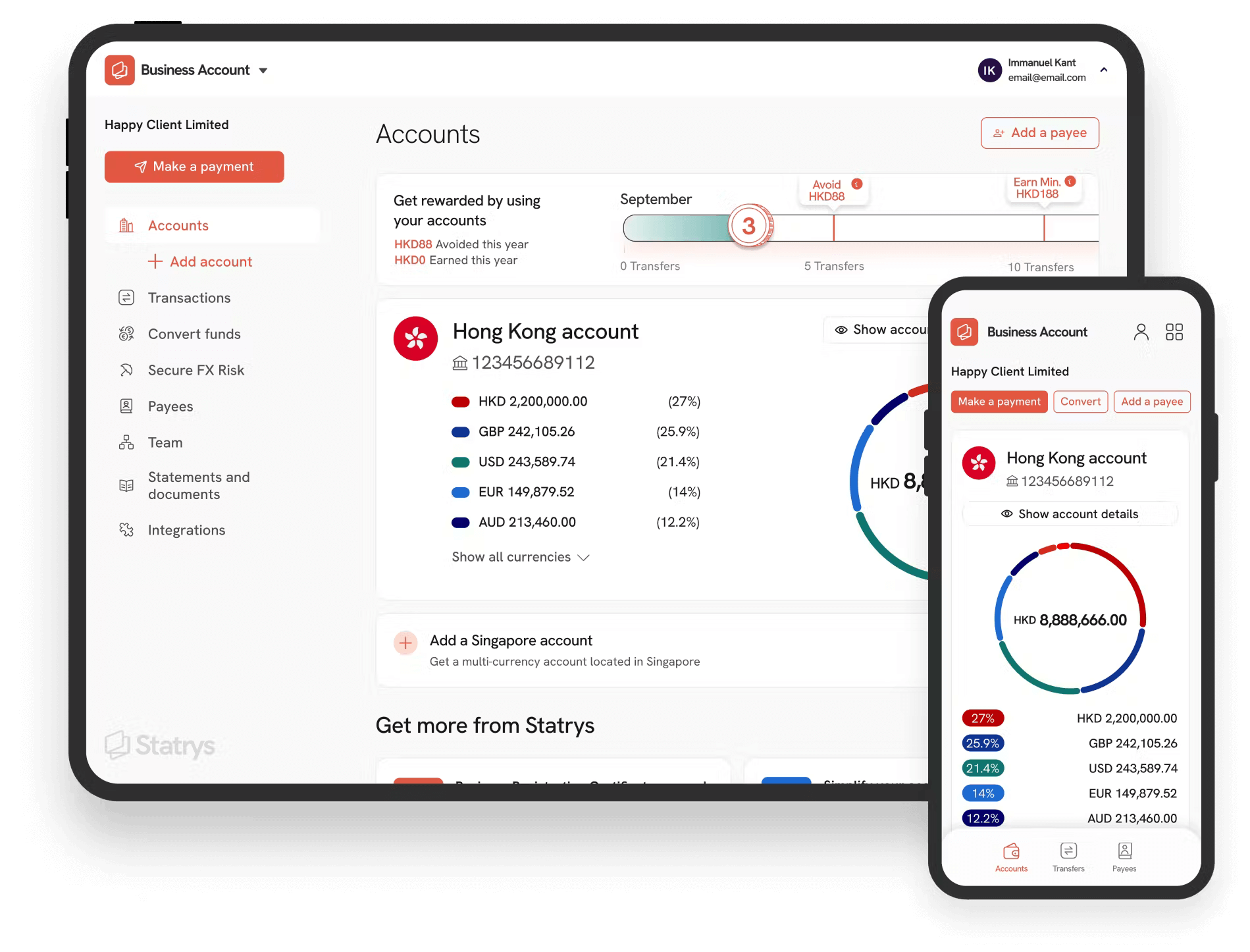
| Statrys | Hold 11 major currencies in one account, send local payments in 12 currencies, and make international transfers to and from over 100 countries. Designed for companies in Hong Kong, Singapore, and the BVI. |
A Quick Guide on Opening a Foreign Currency Account
1️⃣Choose a provider
Compare banks and fintechs based on supported currencies, fees, and online access.
2️⃣Prepare documents
Most providers will ask for:
- Proof of identity (passport or government-issued ID)
- Proof of address
- Business registration documents (for business accounts)
- Information on the nature of your transactions
3️⃣ Apply online or in-branch
Go to the provider's website to find out their process. Fintech and neobank accounts can usually be opened 100% online, while traditional banks may require an in-branch visit.
4️⃣Complete Verification and Compliance Checks
Providers are required to perform Know Your Customer (KYC) and anti-money laundering (AML) checks. You may be asked additional questions about transaction volumes or counterparties.

Opening an account in the US? Learn more about how to open a foreign currency account in the US
Considerations When Opening a Foreign Currency Account
Just as with opening any regular bank account, it's essential to shop around to ensure you choose the right foreign currency account.
Here are some factors to consider when choosing a foreign currency account.
1
Currency Choice
When opening a foreign currency account, the main thing to consider is the supporting currency.
If you handle international transactions or run an ecommerce business, a multi-currency account that supports major currencies like EUR, GBP, JPY, CNY, and AUD is essential. If you need to work with a less common currency, options become more limited, so you’ll need to research providers carefully to find one that can handle it efficiently.
2
Fees
Another key factor to consider is the various fees associated with the account, including the following:
- Account opening fee: Some banks may charge an initial fee to open an account, particularly for corporate clients.
- Monthly fee: Most account providers charge a monthly account maintenance fee. Traditional banks typically charge higher fees, while many fintech providers offer accounts with no monthly charges.
- FX rates and fees: Conversion costs are made up of three parts: the exchange rate itself, any markup added to that rate, and currency conversion fees, which are fees charged to process the conversion. These vary by provider and can significantly affect the total cost of a transaction.
- Transaction fees: Fees are typically charged for international wire transfers and sometimes for incoming funds. The cost can vary depending on the currency and the transaction amount.
- Other fees: These can include fees to deposit or withdraw funds in cash, initial deposit and minimum balance requirements, and potential fees for closing the account.

Useful Tip: To ensure cost-effective international transactions, make sure your account supports SWIFT payments and offers fee-free conversions between currencies held in the account.
3
Debit Cards and Oversea Withdrawals
A foreign currency account should allow easy cash withdrawals worldwide through international ATMs. Many providers also offer multi-currency debit or credit cards, which automatically convert payments into the local currency at the point of sale, making them especially useful for international spending.
In some cases, these cards also come with added perks such as cashback rewards or airport lounge access.
Multi-Currency Account in Hong Kong: Statrys
If you have a company incorporated in Hong Kong, Singapore, or the BVI or are planning to expand to Asia, Statrys is one option to consider for a foreign currency account.
Founded in 2020, Statrys is a Hong Kong-based payment service provider offering multi-currency business accounts, as well as company incorporation services in Hong Kong and Singapore.
Statrys is not a bank, but with a Statrys business account, you can
✅Hold and manage 11 major currencies, including USD, HKD, CNY, AUD, EUR, GBP, SGD, JPY, CHF, NZD, and CAD, all under one account number. You don’t need to open a separate foreign currency account for each one.
✅Send local payments in 12 currencies: USD, AUD, GBP, EUR, THB, INR, VND, TRY, IDR, PHP, SGD, and KRW
✅Send and receive payments in 100+ countries with real-time tracking
✅Competitive foreign exchange service
✅Support via phone, email, WhatsApp and WeChat
✅100% online application
FAQs
What is a Foreign Currency Account?
A foreign currency account is an account that allows you to hold one or more currencies other than the local currency. Foreign currency accounts are useful for those who regularly send and receive international payments, minimizing currency conversion fees.